
Introduction: Research Methods in the Study of Religion(s)
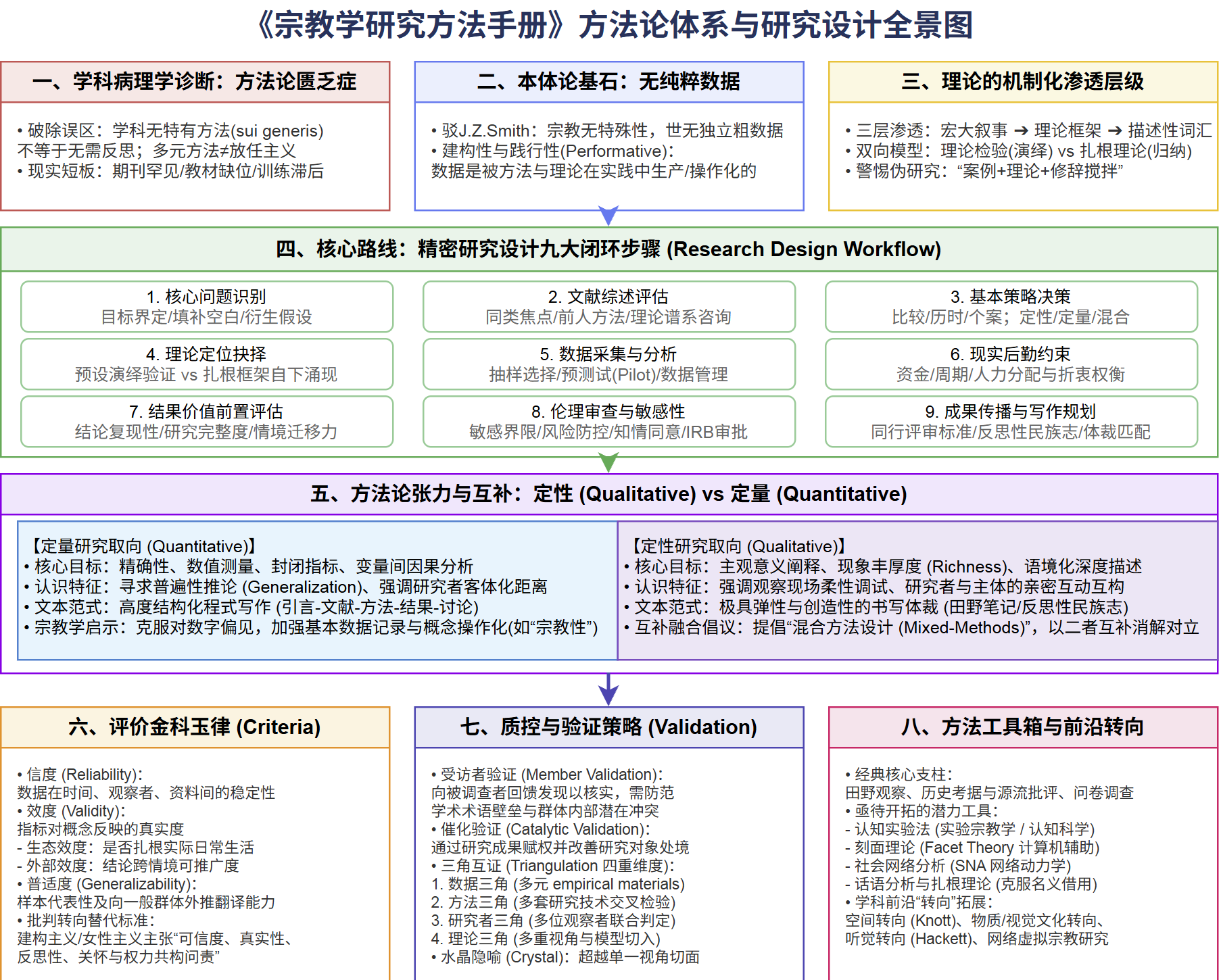
权威引注
Michael Stausberg and Steven Engler, "Introduction: Research methods in the study of religion(s)", in The Routledge Handbook of Research Methods in the Study of Religion, London: Routledge, 2011, pp. 3–20.
Michael Stausberg and Steven Engler
It is generally agreed that methods, together with theories, concepts and categories, 1 are foundational for modern science: knowledge accepted as 'scientific' must be based on empirical materials (data) gathered by using methods that are accepted as 'scientific', and their analysis must proceed following rules based on 'scientific' methods by engaging concepts and theories accepted by the respective academic community. Scholars' dreams, for example, are not accepted as scientific data; allegorical interpretation of such dreams is not accepted as a scientific method; illumination is not generally accepted as a scientific category; and astrology is not accepted as a scientific theory. 2 Of course, rules for what qualifies as scientific data, methods, categories and theories are subject to change. The discussions and critiques that motivate such change are a basic task of scholarship. In addition, scientific data, findings and theories are constantly challenged by non-scholars. Conversely, the borderlines between what is science and what is non-science, or pseudo-science, are matters of ongoing debate and negotiation.
学界普遍公认,方法与理论、概念及范畴 1 共同构成了现代科学的基石:被认可为“科学”的知识,必须建立在运用公认为“科学”的方法所收集的经验材料(数据)之上,且对其分析必须依循基于“科学”方法的规则,并调动相应学术共同体所接受的概念与理论。例如,学者的梦境不能被视作科学数据;对此类梦境的寓言式阐释亦非科学方法;神秘灵光/神启(illumination)一般不被接纳为科学范畴;占星术更不能算作科学理论。 2 当然,界定何为科学数据、方法、范畴与理论的标准并非一成不变。推动这一演变的讨论与批判构成了学术研究的基础使命。此外,科学数据、研究发现与理论也时刻面临着来自非学界人士的质疑与挑战;反之,究竟何为科学、何为非科学或伪科学,其边界本身就是一个持续处于争辩与协商之中的动态过程。
The past decades have seen vivid debates about conceptual and theoretical issues in the study of religion(s). The very concept of 'religion' has been challenged as a valid theoretical category; feminism, postmodernism, poststructuralism, postcolonialism, philosophy of language, evolutionary theory, the cognitive sciences and other intellectual developments have raised a number of epistemological, semantic and methodological issues (i.e. questions regarding the nature, construction, foundations and production of knowledge and meaning); there has been a wave of new theories of religion (Stausberg 2009). So far, however, these debates have remained curiously distant from issues of methodology.
近几十年来,宗教学界围绕概念与理论议题展开了极为热烈的论辩。“宗教”这一概念本身作为有效理论范畴的合法性受到了强烈质疑;女权主义、后现代主义、后结构主义、后殖民主义、语言哲学、进化论、认知科学等思潮的演进,提出了一系列认识论、语义学与方法论层面的重大问题(即关涉知识与意义之本质、建构、根基与生产机制的追问);同时,学界也涌现出一波又一波新的宗教理论(Stausberg 2009)。然而耐人寻味的是,迄今为止,这些热烈的理论争鸣却始终与具体的方法论议题保持着奇异的疏离。
宗教学对研究方法的漠视 (The neglect of method in the study of religion(s))
Issues of research methods are seldom addressed at conferences. Very few articles on methods have been published by leading journals, even in the one that has 'method' in its title. 3 Methods are rarely discussed in introductory textbooks 4 and separate courses on research methods are seldom included in religious studies programs. 5 In this respect, the study of religion(s) stands in marked contrast to other disciplines, which put great emphasis on training in research methods—often in the first year—and which have a strong record of published work on methods, including journal articles, handbooks and specialist volumes. There are no discussions in the study of religion(s) that can compete with the level of technical sophistication established in many other disciplines. 6 The present volume is intended as a significant step toward putting research methods more firmly on the agenda of the study of religion(s), especially for graduate students.
在宗教学术会议上,研究方法议题极少受到关注。主流权威期刊发表的关于方法的论文寥寥无几,即便是刊名中赫然带有“方法”(Method)字样的期刊亦是如此。 3 入门级导论教材罕有专门探讨方法者 4,宗教学学位培养方案中也极少开设独立的研究方法课程。 5 在这方面,宗教学与其他学科形成了鲜明的反差——其他学科通常高度重视方法训练(往往贯穿研究生入学第一年),并在方法论出版方面积累了丰硕成果,涵盖期刊专题、手册及专著。宗教学内部对于方法的讨论,目前尚无法比肩许多成熟学科所确立的技术精密度。 6 本书的编纂,正是为了迈出关键一步,将研究方法真正置于宗教学界的核心议程之上,特别是为研究生群体提供坚实的方法论支撑。
There are several reasons for the general neglect of research methods in the study of religion(s). A major one is the fragmentary situation of our research landscape, in which some scholars learn textual methods while others become familiar with qualitative social inquiry as part of their training. This relates to the often-heard claim that the study of religion(s) is different from other disciplines because it has no research methods of its own. The fact that the field has no sui generis methods is true, and obviously so: almost no discipline does. The analysis of compositions in music comes to mind as a distinct method, but even the study of music uses a range of common methods such as historiography and source criticism or fieldwork. All academic disciplines use a wide variety of methods, most of which they share with others. Fieldwork has never been the exclusive domain of anthropology, and sociologists are not the only scholars who conduct surveys. It is therefore a misconception to think that the study of religion(s) is significantly different from other disciplines in its use of a variety of methods; what is different is the scarcity of explicit reflection on methods in the study of religion(s).
宗教学普遍漠视研究方法的原因有多重。首要原因在于我们学术版图的割裂现状:在学术训练中,一部分学者专精于文本释读与文献考据方法,而另一部分学者则偏向质性社会调查。这又与一种常见论调紧密相关——即认为宗教学有别于其他学科,是因为它“没有属于自己的专属研究方法”。宗教学确实没有所谓“自成一格”(sui generis)的独门方法,这是显而易见的事实,但几乎所有学科亦复如是。音乐学中的作品曲式分析或许算是一种专属方法,但即便是音乐研究,也广泛依赖史学编纂、史料考辨或田野调查等通用方法。所有学科都在使用多种多样的方法,且绝大部分方法都是跨学科共享的。田野调查从来不是人类学的专属领地,社会学家也不是唯一开展问卷调查的学者。因此,若认为宗教学因使用多种方法而与其他学科截然不同,完全是一种误解;真正的区别在于:宗教学界极度缺乏对方法的自觉反思。
Conversely, one often hears that the study of religion(s) is a multi- or pluri-methodological discipline. Again, this amounts to merely stating the obvious. How could it be otherwise? Given the complex nature of most of the things, facts or affairs that are studied in the humanities and the social sciences, there simply are no disciplines that could afford to rely on one method only. There is, in fact, a general consensus (at least outside of the study of religion(s)) that different methods should, if possible, be combined in order to achieve stronger results. A multi- or pluri-methodological approach is far from an anomaly. What is anomalous is the implicit conclusion derived from this insight, namely that issues of methods do not require attention (because there is no one method anyway). Actually, unless one mistakenly identifies methodological pluralism with methodological laissez-faire and dilettantism or with the belief that all methods are equally good for all purposes, one would anticipate precisely the opposite conclusion: that the challenge of having to work with and train students in a variety of different research methods requires substantial and explicit attention and commitment to issues of research methods. Given the nature of the discipline of the study of religion(s), then, we would expect to find a deep and abiding interest in training students in methodology, in refining research methods and in methodological creativity. This is clearly not the case. Rather, method use in the study of religion(s) continues to be relatively unsophisticated and surprisingly uniform. It is time for this to change. For a relatively well-established discipline such as the study of religion(s), it is more than a little embarrassing that the present volume appears to be the first handbook of research methods ever published in English. 7
反之,学界又常听闻宗教学是一个“多方法”或“多元方法论”(multi- or pluri-methodological)并存的学科。同样,这不过是陈述了一句显而易见的大白话。试想怎能不如此?鉴于人文与社会科学所研究的对象、事实与事象极其繁复,没有任何学科能够仅凭单一方法安身立命。事实上,学界(至少在宗教学之外)已达成共识:只要可能,应当综合运用不同方法以取得更为强健的研究结论。采用多元方法论绝非反常之举;真正反常的,是由此洞见推导出的荒谬结论——即既然没有唯一的专有方法,那么方法论议题也就不值得深入探讨了。事实上,除非人们错误地将“方法论多元主义”等同于“方法论放任主义与业余浅尝”,或者盲信“所有方法针对所有研究目的都一样管用”,否则必然会得出截然相反的结论:正是因为必须面对并训练学生掌握多种不同的研究方法,才更加迫切需要对方法论问题给予实质而明确的聚焦与深耕。鉴于宗教学的学科特质,我们理应期待学界对研究生方法训练、方法打磨与方法创新抱有深刻而持久的热忱。然而现实却大相径庭:宗教学的方法运用依然显得相当粗放,且单一得令人惊讶。改变这一现状刻不容缓。对于一个建制相对成熟的学科而言,本书竟然是英语世界出版的第一部宗教学研究方法手册,这本身就颇显尴尬。 7
何谓方法 (Methods)
As indicated above, the present volume starts from the basic assumption that methods are the rules of the game in scholarly work. Resonating the Greek etymology of the word (from meta 'after' and odos 'way'), the concept is understood here as a metaphor to refer to a (planned) 'way', a specific way of doing things, an organized procedure. A scientific method, in very broad terms, is the generally accepted mode of procedure in the sciences in a broader sense (including the humanities). In the light of theories, methods construct, collect and/or generate the data for scholarly work. Data are not simply 'out there', independent of the observer and the observation. There are no data without methods and theories. Methods help us to analyze reality but, at the same time, they, in part, produce the data that are to be analyzed. In that sense, by partially producing the realities they then go about to analyze, methods are performative (Law 2004: 143). Methods, and the concepts that inform them and describe them, also have a history, changing across scholarly generations (see Platt 1999: 44–52). The goal of this volume is to give a sense of current methods and discussions of method in the study of religion(s).
如前所述,本书立足于一个基本假设:方法是学术研究中的“游戏规则”。溯及该词的希腊语词源(源自 meta“追随/在……之后”与 odos“道路/路径”),“方法”在此被理解为一个隐喻,意指一条(经过规划的)“道路”、一种具体的行事方式、一套条理严密的步骤。广义上的科学方法,乃是宽泛意义上的诸门科学(涵盖人文学科)中公认的程式规范。在理论的照见下,方法为学术研究建构、收集并/或生成数据。数据绝非孤立地“客观存在于外部”,不受观察者与观察视角的制约。没有不带方法与理论的纯粹数据。方法既助我们剖析现实,但与此同时,它本身也在相当程度上生产出有待分析的数据。在此意义上,方法因其部分地“生产了”它随后要去分析的现实,而具有了生成性/施行性(performative, Law 2004: 143)。方法及其概念本身同样具有历史性,随一代代学人的更迭而演进(见 Platt 1999: 44–52)。本书的宗旨,正是为了呈现当下宗教学研究中的现行方法与前沿讨论。
It is clear that some methods are more helpful than others (for given purposes and within given contexts), that different types of scholarly work make more productive use of some methods than others, and that all methods impose limited perspectives and select empirical materials (data). These obvious facts, however, do not make methods dispensable, for there is no scholarly (or scientific) work without method(s). This should not be misunderstood as saying that there is one special method that guarantees success, that following a method guarantees success, that methods are beyond critique, or that established scientific methods are the only way of obtaining relevant knowledge (though scientific methods are the only generally recognized way of obtaining scientific knowledge). Methods are not a straitjacket; they allow for creativity and new vision. Not everything can be planned out, of course, and not every plan can be put into practice. In fact, scholarly work is often steered more by external constraints, by improvisation and by bricolage than by a master plan. While methodological competence will yield solid work, brilliant work is often the result of serendipity. Creative scholarly work does not go against method, but creatively uses methods; as all good tools, methods are refined in use: some wear out and are replaced by others; some are broadened or reoriented in light of their limitations or when facing the threat of perceived methodological hegemony or imperialism (Law 2004).
显而易见的是,某些方法会比另一些方法更具成效(针对特定目的并在特定语境下而言);不同类型的学术研究对某些方法的运用也会比其他方法更富生产力;并且所有方法都会带来有限的视角并对经验材料(数据)进行筛选。然而,这些显见的事实绝不意味着方法是可有可无的,因为脱离了方法,就根本不存在所谓的学术(或科学)研究。但切不可由此误以为存在某种能够确保成功的“灵丹妙药”式特殊方法,或是以为只要依循某种方法就必然马到成功,抑或认为方法是不容置疑的、公认的科学方法是获取相关知识的唯一途径(尽管科学方法确实是公认获取科学知识的唯一正途)。方法绝非束缚思想的“紧身衣”,它同样为创造力与新视野开辟了空间。当然,并非所有事情都能被预先规划,也并非每项计划都能付诸实践。事实上,学术研究往往更多地受到外部环境约束、即兴发挥以及“修补术”(bricolage)的驱动,而非完全依凭宏大的蓝图。方法论素养能保障产出扎实可靠的成果,而卓越绝伦的传世之作则往往伴随着意外机缘(serendipity)。具有创造力的学术研究绝非与方法背道而驰,而是富有巧思地运用方法;正如所有精良的工具一样,方法在实践中被不断打磨磨砺:有些因过时而淘汰并被取而代之;有些则因其局限性,或在面临方法论霸权与帝国主义威胁时,被赋予更宽广的内涵或被重新校准方向(Law 2004)。
In a formal sense, research methods are techniques for collecting and analyzing, or enacting (Law 2004) data in scientific or scholarly research. While there is always some degree of improvisation, these procedures or techniques typically follow a plan, a routine or a scheme. These established procedures should not be misunderstood as immutable laws, but as guidelines and examples of established or best practice (which is not to deny the dynamism of practices). Accordingly, the present volume does not intend to regulate or standardize research practice in the study of religion(s) but to improve research and to stimulate its further development by providing reflection and suggesting alternatives.
从形式意义上讲,研究方法是科学或学术研究中用于收集和分析、或曰“生成/施行”(enacting, Law 2004)数据的技术手段。尽管始终存在某种程度的临场应变,这些步骤或技术通常依然遵循一定的计划、规程或方案。但这些约定俗成的规程绝不应被误解为不可逾越的铁律,而应视为业已确立的、最佳实践的指引与范例(这并不否定实践本身的动态发展性)。因此,本书绝非旨在规训或标准化宗教学的研究实践,而是希望通过提供批判反思与多元替代方案,以提升研究品质并激发学科的深层发展活力。
Some key methodological issues
The application and discussion of the underlying principles of these procedures is called methodology. Methodology refers both to general technical issues regarding methods (i.e., case or sample selection, data collection and analysis), and to the theory and conceptualization of methods. We will address each of these in turn.
Research design
The first, technical sense of 'methodology' incorporates several issues: e.g. research design; relations and tensions between qualitative and quantitative methods; selection of methods; and means of validating results, including the use of different methods in conjunction.
Research design is covered in a separate chapter in this volume (see Chapter 1.5). Here we will confine ourselves to listing some of the basic steps involved in effective research design: 8
Identifying the core research question or problem and the series of specific questions or hypotheses that will investigate, support or elaborate that core issue (What is the goal of the study? What lacuna is it meant to fill? What motivates the desire to generate knowledge on this particular issue? What more specific issues will serve as stepping stones to generating that knowledge?).
Reviewing the relevant literature (What has been published that is comparable in terms of substantive focus, methods and range of theoretical approaches used with similar issues and materials? What will the proposed study add? Are there experts in the area with whom one can consult?).
Choosing a basic strategy (What sort of study seems best suited to addressing the core research question [comparative, retrospective, longitudinal, case-based]? Does a qualitative, quantitative or mixed-methods approach seem more promising? [see also below]).
Deciding on the place of theory (e.g. Is the choice of theory established from the start, as when applying or testing a theory, or will one or more theoretical frames emerge during analysis?).
Specifying methods of data collection and analysis (Which precise method(s) will be used? How will this/these address the research question and hypotheses? How will a case or sample be chosen, and how does this choice relate to other questions on this list? Is a pilot study or a pre-test of the data collection instrument(s) warranted? How will data be managed?).
Dealing with logistical constraints (How will limited resources of money, time, assistance be distributed?).
Assessing the value of the results (To what extent are the results of the study repeatable? What is the integrity of the results? Are the conclusions applicable to other contexts? [these issues are addressed in greater detail below]).
Identifying ethical values, issues and potential problems (Is the topic researchable or is it too sensitive? Are any additional ethical principles and/or risks potentially involved in the research? What is the relevant institutional procedure for obtaining ethics approval? [this issue is addressed in a separate chapter on research ethics in this volume—see Chapter 1.6]).
Planning ahead for dissemination (How will the results be presented for peer review? What genre(s) of scholarly presentation/writing will be used? Will these choices impact other aspects of the study, e.g. requiring especially reflective field notes in order to write in a more reflexive ethnographic style?).
Quantitative and qualitative methods
One of the most significant of debates in methodology concerns the use of quantitative versus qualitative methods. To simplify, quantitative methods employ numerical measurement while qualitative researchers do not. Disagreements reflect basic positions on research design: some advocates of qualitative approaches argue that certain things are simply not amenable to measurement; while some advocates of quantitative methods criticize the subjective nature of qualitative work. 9 However, it has also become clear that there is significant overlap and that the distinction sometimes breaks down. Quantitative and qualitative methods are often combined in mixed-method research designs. 10 Beyond the sociology and to some extent the psychology of religion, quantitative approaches are currently not very popular among scholars of religion, who appear, as a group, somewhat biased against such approaches. However, one should not ignore the crucial interpretive dimensions of quantitative work such as the construction of variables to measure concepts—think of the intricate question of how to measure 'religiosity'. Moreover, scholars of religious groups—in particular of marginal ones—often neglect to provide elementary quantitative data, which would be very useful for other and later scholars (Pitchford et al. 2001). While there are some prototypical quantitative or qualitative methods such as statistical surveys (quantitative) and unstructured participant observation (qualitative), one finds quantitative and qualitative varieties within the scope of most research methods (e.g. content analysis, discourse analysis, interviews, etc.).
The distinction between these two types of methods remains widely used, but it is interpreted in different ways. At best, the distinction may be useful to distinguish tendencies and general perspectives on research interests and strategies:
quantitative methods are often more focused on precision (e.g. closed-ended or categorical questions), qualitative methods on richness (e.g. open-ended questions);
quantitative methods are often more concerned with generalization, qualitative methods with description;
quantitative research is often more structured (e.g. emphasizing the use of data collection instruments), while qualitative research is more flexible (e.g. emphasizing the selection of observation sites);
quantitative methods tend to address relations between variables, while qualitative methods tend to investigate the meaning that individuals and groups ascribe to human or social phenomena;
quantitative methods often have a more distant relationship to their objects, while qualitative methods presuppose a closer relationship to their subjects;
quantitative methods generally produce results that are amenable to statistical analysis, while qualitative methods necessarily use less formalized techniques, for example in potentially assessing the representativeness of samples or the validity and significance of results; and
quantitative methods are generally associated with very structured forms of scholarly writing in the dissemination of results (including literature review, method(s), results and discussion/conclusion), while qualitative methods are associated with a much wider, more flexible and often creative range of genres and styles.
Criteria of excellence
Three well-known criteria for evaluating the goodness of research data are their reliability, validity and generalizability. In a general sense, reliability refers to the consistency or stability of data or measure of a concept; validity refers to whether an indicator (or a set of indicators) accurately reflects (or measures) the concepts it was designed to reflect or, alternatively, whether it accurately predicts relevant outcomes; and generalizability refers to the applicability of findings beyond the sample of a given study.
The literature distinguishes between different forms of reliability and validity, and methodological research has developed methods for judging and improving the achieved degree of these criteria of excellence (at least for some methods). This has led to the elaboration of various fine-tuned conceptual distinctions. These are best addressed in relation to specific sets of methods in given frameworks of studies (i.e. research designs).
These concepts raise important issues that are relevant when conducting and assessing research. Regarding reliability one might ask, for example:
To what extent would the findings be different had the data been collected at a different date, with a different sub-group, or based on different source material?
Would two or more observers or interpreters come to the same, or at least similar, results when looking at the same data (and would two or more researchers have produced the same, or at least similar, data in the first place)?
Regarding validity one might, for example, pose the following questions:
Are the constructed data sufficiently relevant and specific for the object of study?
Would findings still be accepted if other relevant theoretical criteria were applied?
To what degree do the findings relate to people's ordinary lives beyond the context of the study itself ('ecological validity')?
Would the analysis stand if data collected with other methods were considered? (E.g. would the analysis of a ritual based on a philological analysis of the textual sources yield the same interpretation as one based on participant observation? Would an interpretation based on interviews with the main actors yield the same interpretation as the interviews with observers?)
To what extent can findings be generalized across the social settings studied ('external validity')?
Regarding generalizability one might ask, for example:
Is the chosen case or sample sufficiently representative, typical, exemplary or compelling that the findings are likely to apply to relevant broader groups?
To what extent and in what ways does the analyzed case fit with other cases? Can it be translated to other cases?
To what extent is the analysis relevant for broader (systematic and theoretical) issues in the study of religion(s)?
What degree of generalizability is appropriate or desirable (from sample to population, or even more broadly to similar populations)? Is this a micro-study that addresses only a particular case?
Obviously, questions such as these are pertinent to research in the study of religion(s). Scholars have suggested several strategies for increasing the validity of research. For engaged or ideologically committed scholarship, findings can be validated in a catalytic manner, i.e. if the study helps the concerned people to improve their situation. In mainstream scholarship, a central form of validation is academic communication, for example by discussion and peer review. Another more specific strategy is known as respondent (or member) validation: in order to receive feedback, scholars present their findings to the people with or about whom they have conducted research. This strategy (which can be practiced in various forms and is only available when studying living groups) can be used as a way to corroborate research findings, as a further step in the collection and analysis of data and/or as a way to enhance reflections on the research process by the researcher. While this strategy can save one from errors and generate new insights, corroboration by the subjects (which can sometimes be unintentional, such as when informants implicitly confirm an interpretation by rejecting it) is not itself sufficient to validate research. Subjects may not understand the scholarly terminology and mode of discourse and may not even have the time to read long texts and—perhaps not only for them—often tedious arguments. While potentially helpful, it can result in conflicts either between the researcher and the group or among the people themselves. In many cases, however, the people we study are genuinely interested in seeing research findings, and such requests should not be ignored.
Another strategy for validating research is triangulation. 11 This refers to the use of more than one method and/or more than one source (or type) of empirical materials in a study. The metaphor of the triangle points to the multiplicity of perspectives on method and data. 12 Apart from involving different (or different variations of) methods and data, the concept also refers to engaging more than one researcher (observer) and/or theory. This reflects the view that differences between methods and their various implications need to be actively accounted for. Triangulation is often regarded as part of mixed-methods research. Even if this is not practicable for most single research projects in the humanities, which are typically conducted by one investigator with strictly limited time and resources, integrating elements of triangulation are useful for smaller projects as well. Methodological pluralism does not teach that all methods are equally good or bad for each and every task. In any case, the selection of appropriate research methods is an important methodological issue, which all researchers will need to address.
The concepts of reliability, validity and generalizability underline the necessity of reflecting on the quality of research regardless of the general approach one takes. Yet, these concepts have also been challenged during past decades because of their implicit affiliation to (post) positivist views of science and methodology. 13 Accordingly, other views of science invoke other criteria for evaluating research. Constructivist views, for example, have pointed to credibility, authenticity, confirmability and transferability of research (Guba and Lincoln 1994; Auerbach and Silverstein 2003). Recall also the committed or engaged research mentioned above. Ethnic, feminist or queer theoreticians, on the other hand, would point to concepts such as accountability, caring, dialogue or reflexivity as criteria for the goodness of research (Denzin and Lincoln 2005: 24). Feminist critics, for example, argue that 'validity' and related concepts tend to be interpreted in universalizing and hegemonic terms, failing to recognize the situated and co-constructed nature of truth. That is, the premise that research should be vetted as 'trustworthy' by establishing its fidelity to some objective social 'reality' defines truth as a universal relation to reality 'out there'. This constructs a mode of access to knowledge that is policed by those whose institutional positions are invested in ideological norms like 'validity'; it denies the ways in which the nature and legitimacy of knowledge is a function of situated, and power-laden, interpersonal relations.
Data, theories and methods
This leads us to the second, 'philosophical', sense of the term methodology, which is intimately connected to wider discussions in the philosophy of science and epistemology (see Chapter 1.3 on the latter in this volume). There are some important underlying philosophical (ontological and epistemological) issues, the most general of these being, 'what is reality and how can we obtain knowledge of it?' More specifically, taking methodology seriously forces us to ask hard questions about our research processes, questions that scholars of religion(s) avoid at the risk of producing substandard research. At the same time, it is important to recognize that there is no neat correspondence between epistemological positions (e.g. on how we come to know about the world) and methodological stances (Platt 1999: 110–11).
A fundamental lesson from the philosophical end of the methodological spectrum is that data and theory are closely related. 14 Addressing this issue clarifies the place of method. Qualitative scholars often prefer the term 'empirical materials' to 'data', rejecting the positivist legacy of the latter concept. We prefer 'data', for the most part, granted the qualification that the current methodological and theoretical landscape takes a variety of stances on this concept.
One value of the traditional term is to clarify the legacy of Jonathan Z. Smith's oftenquoted, but misleading claim that 'there is no data for religion' (Smith 1982: xi; original emphasis). 15 In one sense, Smith reminds us of one implication of the rejection of logical positivism. As Charles Taylor notes, that early twentieth-century attempt to define meaning in terms of what was verifiable drew a distinction between interpreted data and 'brute data': 'Verification must be grounded ultimately in the acquisition of brute data [... i.e.] data whose validity cannot be questioned by offering another interpretation or reading.' This distinction is best rejected, not least due to 'the perpetual threat of skepticism and solipsism inseparable from a conception of the basic data of knowledge as brute data, beyond investigation' (Taylor 1971: 8). If we read 'data' as 'brute data' in this sense, then Smith's claim is misleading because it reinforces the specialness of 'religion' even as it attempts to undermine it. That is, by noting that there are no (brute) data, Smith repeats a well-known but important lesson; however, by speaking of 'data for religion', he seems to imply that there is something special about the religious case. Two issues must be kept separate here: the claim that there are no brute data period, for religion or anything else; 16 and the claim that there are no essentially religious facts, the religiosity of which is independent of our scholarly operations. The latter, however, is merely a specification of the same point, in effect the other side of the same logical coin; once again, 'religion' is not special in this sense. Granted that all data are interpreted (not just interpretable), this aspect of Smith's famous claim points to one way in which that interpretation takes place in all cases where theory is central, not just in the study of religion(s). There are no essentially religious facts in the same sense that there are no essentially economic or essentially political facts: 'religious', 'economic' and 'political' are terms that scholars (but not only scholars!) use to delimit a set of phenomena of interest. That is, there clearly are data for religion, i.e. phenomena that have come to be classified as 'religious' through the conceptual/ theoretical work of scholars of religion(s), among others. 17 In essence, once we distinguish between 'facts' out there and observational 'data', Smith's famous claim effectively says the opposite of what it seems to say: i.e. 'there is nothing but data for religion'. That is, the empirical materials that are accepted as data in scientific (scholarly or academic) communication in the study of religion(s) are constructed, collected or produced by methods accepted as scientific, the goodness of which has been evaluated by using some of the criteria mentioned above.
Theory plays a different role in different research designs, and this impacts the role of methods. We can distinguish roughly between different models along an often-disputed continuum of scholarly praxis, which cannot be discussed here in any detail. At opposite ends of the spectrum are the models of theory testing (scientific method) and theory building (grounded theory). In scientific method, a theory refers to a body of statements (axioms and hypotheses), which are constantly being tested and revised, through empirical verification and falsification. Experiments are the classical method of that type of inquiry, while surveys and other quantitative methods play an analogue function in the social sciences. Grounded theory, on the other hand, refers to a model of scholarly practice which does not use data to test theory, but which builds concepts, categories and, ultimately, theory from a dynamic interplay between the collection and analysis of data (see Chapter 2.10).
Between these two extreme models, there are differences as to where exactly theory enters the scene. In our discipline, many projects select empirical materials or cases not because of some theoretical issue or problem that the respective case or material is expected to illuminate, but because students or scholars are excited by some phenomenon that they have encountered, often among friends, in the media, or on their travels. They then start reframing this as a topic worthy of scholarly attention. All too often, the theoretical relevance of the case is then projected on the case a posteriori, maybe out of a tentative first analysis, and one or the other theoretical perspective is then applied. The recipe reads: choose a case; choose a theory; add rhetoric and stir.
This, however, is problematic with respect to both theory and method. If we presuppose that data are just 'out there' in the world—like insects sought by an entomologist—then theory and method are relatively minor issues of choosing a net and learning how to wield it. The case is very different when we recognize that the complex interplay between theory, methods and data not only shapes our resulting collection of bugs but plays a basic role in orienting the choice to search for these particular things, in constructing the categories that frame these 'objects' (e.g. 'species', 'insect', 'butterfly', 'wing'), and in guiding our hand at each step of our search.
Apart from being a result of analysis—or sets of statements to be tested—theory is present in the research process in various manners and on different levels. On the one hand, scholarship often operates within shared theoretical horizons, grand theories, or Grand Narratives. Almost any religious fact from the present and the past century, for example, is reflexively interpreted as a symptom of 'modernity' or 'postmodernity' and often linked to the affiliated theory of secularization (or its alternatives such as resacralization). These horizons are metatheoretical because they can be explored by using various theoretical frameworks (critical theory, poststructuralism, systems theory, etc.), which make for a different level of theory. These theories put a theoretical vocabulary at the disposal of scholars, who often combine terms with various theoretical legacies in their redescriptions of empirical materials. Descriptive vocabularies provide yet another level of theoretical imprint. While scholars of religion(s) share a wide range of their vocabulary with the non-academic world (starting with the very category of religion), scholarly communication requires a specific form of articulation, which insists on a reflexive approach to our vocabulary and to its definitional and theoretical dimensions. The term 'ritual', for example, is used widely in every possible corner of public discourse, but at the same time it is subject to a wide body of scholarly theorizing (Kreinath et al. 2006, 2007), and one expects scholarly uses to reflect the latter in order to pass as scholarly discourse. When analyzing empirical cases, this critical engagement of a theoretical vocabulary within given theoretical horizons and frameworks is a methodological challenge, which amounts to a kind of reciprocal translation between data and theory. Concepts and categories need to be made workable (operationalized) for analysis, and in analyzing cases, theory and data infiltrate each other and can no longer be separated from each other (granted they ever were separable). Of course, different concepts of and theories of religion influence the kind of data and methods that one considers legitimate for use in the study of religion(s). It is through methods that data and theory speak to each other and become part of a shared horizon. Failure to recognize this middle-ground role of methods in framing the complex interplay between empirical materials and theory is likely a further reason that methodology is neglected in the study of religion(s).
Aims and structure
Like all handbooks, the present volume seeks to distill knowledge currently available in the field; it takes stock of past and present practices and aims to help shape the future. Not least because the study of religion(s) lags behind other disciplines with respect to methodology, the present Handbook does not aim to provide sophisticated technical discussions of methodological details, nor does it aim to address all possible methodological options that might be available for scholars of religion(s). One practical reason for the latter limitation was the difficulty of finding scholars of religion(s) who could serve as authors, based upon their having actually used certain methods we considered for inclusion.
A variety of neighboring fields are reflected in the range of methods discussed (e.g. fieldwork's relation to anthropology, surveys' relation to sociology, and philology's and semiotics' status as separate fields). In the case of most methods discussed in this volume, a wide range of works has been published on the use of those methods in other disciplines, and all chapters provide suggestions for further reading. Given the scarcity of published work on research methods specific to the study of religion(s), our ambition is to prepare the ground for a closer engagement with research methods. Many chapters are the first published work on a given research method by scholars of religion(s). This has been a challenge for the authors (from nine countries) who were selected because of their active familiarity with the respective research methods and their sensitivity to methodological issues.
Compared to a range of other disciplines, not only has there been a lack of interest in research methods among scholars of religion(s), but there also seems to be only a limited interest in actively exploring new methodological options. Accordingly, one of the main aims of the present volume is to sensitize scholars of religion(s) to the range of methodological options and the many choices that have been and can be employed in scholarship, as well as to their various limitations. It is hoped that the book will stimulate an appropriate and creative use of research methods and help researchers in avoiding methodological pitfalls. At the same time, the chapters in this volume will help readers to evaluate scholarly work and to develop a critical awareness of strong and weak research. Given the centrality of methods for science and scholarly work, reflections on methods and methodological issues are crucial to determine and improve the quality of academic work. The present Handbook thus aims to be of both practical and critical value.
This introductory essay is followed by five chapters that set the stage by addressing some fundamental issues for any kind of research. These include discussions of epistemological problems (Jeppe Sinding Jensen), research ethics (Frederick Bird and Laurie Lamoureux Scholes), research design (Wade Clark Roof), and comparison (Michael Stausberg). Issues addressed in these chapters resonate throughout the rest of the volume.
The other chapter included in the introductory section, on feminist methodologies (Mary Jo Neitz), is not a method in a strict sense but a methodological position that suggests ways of using methods as means to empowerment. Standpoint feminism (highlighted in the present volume), resonates with hermeneutics by pointing to the epistemological implications of bias, yet it does not seek to overcome this but rather to turn it into a constructive tool. Apart from entailing a politicization of research, feminist methodologies put a premium on reflexivity, which is also a key issue in several other chapters. There is very little sense of methodology as empowerment in the study of religion(s). This marginalization of activist, committed, concerned, compassionate, critical, engaged and poetic tendencies in qualitative research in the discipline may well reflect its foundational, customary rejection of confessional, theological approaches. 18 In some cases, however, scholars of religion(s) actively support the religious groups with which they are working, for example by sharing advice, supporting them by serving as expert witnesses, or by helping them to deal with state bureaucracies.
The second section of the book offers a sort of methodological menu, allowing readers to choose a method, or contemplate the inter-relations between more than one, at their leisure. The chapters are arranged in alphabetical order (other possible lines of division—e.g. quantitative vs. qualitative, social sciences vs. humanities; text- vs. observation-based, obtrusive vs. unobtrusive, classical vs. recent—all seemed more misleading than helpful). Clearly, there is no particular reason to read all chapters or to read them in this order. We assume that most readers, based on their own perceived interests and needs, will navigate their own course through this book. In order to facilitate this process, each chapter ends with a list of chapters on methods that are 'related' in different ways: those that have a clear affinity with a given method; those that have, in practice, often been used with that method; and those that share common ground in terms of more general issues (e.g. comparison, epistemology, research ethics or research design). This is intended to allow readers to explore their own pluri-methodological networks—to compose their own multi-course meals from the rich menu—and it reflects the fact that methods tend to be neither clearly demarcated nor mutually exclusive. In research practice, methods overlap, even in projects not designed to take advantage of a mixed methods approach. 19 In composing this methodological menu, we took the current practice of the discipline as our starting point. Readers will notice that some chapters are longer than others, namely the ones on field research and participant observation (Graham Harvey), historiography (Jörg Rüpke), and surveys and questionnaires (Juhem Navarro-Rivera and Barry A. Kosmin). We assigned more space to these chapters since much research currently done in the study of religion(s) engages one of these methodological approaches. Even in these cases, however, it turned out that very little discipline-specific technical literature on these methods was available.
Some of the chapters in this volume address methods that are seldom used in the study of religion(s). We include them here in order, ideally, to facilitate their wider reception given their great potential value for scholars of religion(s). While experiments (Justin L. Barrett) are widely used in disciplines such as psychology, they are seldom used in the study of religion(s), with one key exception: the cognitive science/study of religion. Another relatively long chapter—underlining potential value—introduces two methods related to a school of data analysis known as facet theory (Erik H. Cohen). These are techniques for data analysis facilitated by computer software. Network analysis (jimi adams) is little practiced in the mainstream study of religion(s), despite the social nature of religious groups and networks. It also comprises techniques for data collection and data analysis.
In addition, some methods are often invoked by name but rarely put into practice by scholars of religion(s). The notion of discourse, for example, has become prominent in the vocabulary of the study of religion(s). However, this rhetorical preference has not been translated into methodological terms: despite much talk of 'discourse', few scholars of religion(s) have used the methodological tools of discourse analysis (Titus Hjelm). Something similar occurs with grounded theory (Steven Engler), which is both a method and a more general (methodological) view on the relationship between theory, data and method: extant work by scholars of religion(s) often appeals to grounded theory without actually engaging it. It is hoped that this practice of 'methodological metonymy' (Engler) will eventually give way to more coherent methodological practice in line with standards established in other fields.
Other chapters address a methodological scenario rather than a single method in a stricter sense: field research (Graham Harvey) is a lived context where different kinds of data can be generated, and historiography also uses different ways to collect data which are then scrutinized in source criticism and ultimately framed to form an historical narrative.
Given the centrality of texts to the study of religion, several of the methods discussed in this book address aspects of work with such texts, including transcriptions of oral sources. Philology and textual studies (Einar Thomassen) produce data by analyzing textual sources. While philology is often referred to as a traditional method in the study of religion(s) (now in decline, given increasing interest in contemporary religions and decreasing interest in the study of languages), very little has been published about this method by scholars of religion(s).
Since scholars of religion often deal with sources in foreign languages, translation is a key challenge; different problems and issues are here reviewed by an experienced translator (Alan Williams). Conversation analysis (Esa Lehtinen) is mainly a method of analysis of spoken (inter)action. Given the primary importance of verbal (inter)action in most religions one should think that this method would be relevant for a greater share of scholarly work in the study of religion(s). Another variety of textual analysis is content analysis (Chad Nelson and Robert H. Woods, Jr), which has a strong record of application in studies on religion but is relatively little known among mainstream scholars of religion(s).
Other methods offer primarily tools for the collection of data: interviewing (Anna Davidsson Bremborg), structured observation (Michael Stausberg) and free-listing (Michael Stausberg) are primarily used to collect (or construct) data for analysis—in the latter case with a focus on categories. Some methodological innovations depend on technological innovations. The development of video cameras, for example, has allowed a much more fine-grained type of analysis of religious actions, interactions and rituals (Hubert Knoblauch on videography). While questionnaires are devised to collect data, survey methodologies also include techniques for analyzing the data. Factor analysis (Kendal C. Boyd) is an established statistical tool to analyze the inter-relationship between variables and to review the conceptualization of theoretical constructs.
Ultimately, each research method carries a specific philosophical baggage, and by constructing a certain kind of data, all research methods facilitate certain kinds of analysis and thereby privilege certain kinds of perspectives. With some methods, the various philosophical and theoretical backgrounds remain more visible than with others (and sometimes, as in the case of discourse analysis, the theoretical background has become diversified and partly obscured once the methods were used more extensively). The methods sometimes appear as practical applications of the theoretical paradigms (but there normally are different theoretical varieties within such paradigms). Structuralism (Seth D. Kunin), for example, is based on a family of linguistic theories which have been adopted by anthropologists, whose analyses of cultures and religions in turn have inspired scholars of religion(s). Semiotic analysis (Robert A. Yelle) has a related yet distinct historical and philosophical background; in the present context, the focus is on the methodological analysis yielded by these paradigms and theories when applied to empirical materials rather than their significance for theories of religion(s). Hermeneutics (Ingvild S. Gilhus) and phenomenology (James V. Spickard) likewise have long and strong philosophical roots, which have fertilized the study of religion(s) throughout its history. Since hermeneutics addresses the crucial matter of interpretation, it has had a wide impact on the humanities and the social sciences; the chapter in the present volume provides some practical advice for scholars on how to approach texts hermeneutically. Phenomenology, in particular, has been one of the foundational paradigms for the early study of religion(s) (besides comparative linguistics and anthropology); in the present volume, it is presented as a method of empirical analysis.
During the past decade or so, some areas of inquiry have emerged that pose interesting challenges in methodological terms. These are characterized, to some extent, by specific sorts of data or sources and are related to a series of 'turns' that have changed the shape of the study of religion(s) along with other disciplines: e.g. the linguistic turn, the performative turn, the postcolonial turn, the iconic turn, the translation turn, the spatial turn, etc. The impact of several of these 'turns' is felt in the chapters collected in the third section. The methodological dimension of the spatial turn is addressed in a chapter by a scholar (Kim Knott) who has been at the forefront of translating the ramifications of studying religion in its spatial locations to work in the field. Her spatial approach proposes a series of analyses of data collected by a variety of methods. Material culture (Richard M. Carp) and visual culture (John Harvey)
have emerged as key dimensions of religion, and both authors emphasize the broad range of phenomena falling within their respective domains. Among the most recent 'turns' is the auditory turn, and Rosalind I.J. Hackett discusses its impact on the study of religion(s). These areas are characterized by interdisciplinarity and, for obvious reasons, by pluri-methodological research designs. However, while the study of music and art history have developed methods for the study of auditory and visual materials, respectively, these cannot be simply copied for the purposes of the study of religion(s). Finally, our lives, including our working lives, can hardly be imagined without the Internet, yet dealing with the promises and perils of this medium in a methodologically appropriate way requires some rethinking (Douglas E. Cowan).
In sum, this book is meant to contribute to progress along the path of methodological reflection and sensitivity in the study of religion. As readers will soon realize, the selection of methods offered and the detail in which they are explored represent some solid strides, but a long road lies ahead. We hope that others will be assisted or inspired by this collective work to continue the journey on their own. In order to recall the steps taken during this initial sortie, and to offer further guidance, all chapters are provided with glossaries of key concepts and sections of annotated readings.
Notes
Here and throughout the volume, concepts printed in bold are defined in the key concepts section at the end of the respective chapter. We refer to the study of 'religion(s)' (following Stausberg 2010a) in order to index a series of theoretical and meta-theoretical questions regarding the referents and framing of 'religion' and 'religions.' Thanks to Mark Q. Gardiner for helpful comments on a previous draft.
The case that astrology is not a science is argued on various grounds: because of the esoteric nature of its subject matter (i.e. on ontological grounds); because it is unfalsifiable (i.e. on methodological grounds); or because its claims are vague to the point of meaninglessness (i.e. on semantic grounds). Moreover, astrological accounts of the characteristics of individuals are so rich and complex that it would be impossible to find sufficient common cases for a double-blind analysis (von Stuckrad 2007: 357–58, 365).
Lincoln (1996) is one of the few texts published in Method & Theory in the Study of Religion with a focus on methods. Despite the title of this essay, Lincoln's view on methods is remarkably uniform: 'history is the method and religion the object of study' (Lincoln 1996: 225). While this may be so for the history of religions in a narrow sense, the present shape of the study of religion(s) requires a wider methodological arsenal.
Chryssides and Geaves (2007) is a notable exception. See also Svensson and Arvidsson (2010) in the 'further reading' section.
There are many 'methods and theories' courses, but typically methods play at most a minor role.
A noted sociologist of religion recently commented that he 'as a reviewer of papers submitted to journals [... is] often disappointed and sometimes appalled by the lack of specific information provided about the data and methods employed in their analyses' (Smith 2010: 589). We agree with Smith (2010: 591) when he states: 'Data and methods are not minor technicalities that we should impatiently rush past in order to get to our analyses and findings. They are crucial disciplinary matters that help validate the very worth of our analyses and findings.'
Works published in other languages are briefly summarized in the 'further reading' section following the chapter. Stone (2000) edited an interesting collection in which prominent American scholars reflect on their work and the methods they have used.
The following points are meant to reflect roughly the chronology of a typical research design process. However, some of these elements presuppose earlier decisions (e.g. the choice to use a survey supported by interviews coming after the choice to use a mixed methods approach, or the decision to allocate money for transcription coming after the choice to work with interviews).
Qualitative methods have been criticized for failing to live up to the standards set by quantitative methods, which offer more formalized measures of various criteria for assessing the value of research findings. The kinds of studies common in the study of religion(s) (e.g. rhetorical analysis, interviews and ethnographic fieldwork) have been criticized as ungeneralizable: because it is difficult to generalize from one or a small number of cases; and because data collection, the conceptual frames used to interpret data, and the 'application' of theory tend to be somewhat idiosyncratic. Qualitative researchers, on the other hand, tend to emphasize the constructed, negotiated and situational character of reality and the reciprocal relationships between subjects and objects of inquiry. To some extent, this undermines the ground on which quantitative research often is built.
Brink 1995 advocates the use of both quantitative and qualitative methods in religious studies.
Some regard triangulation as an alternative to, rather than as a strategy of, validation.
In more recent discussions of qualitative research, it has been suggested that the metaphor of the triangle should be replaced by that of the crystal. This also takes account of the centrality of writing styles as forms of inquiry; mixed-genre texts (e.g. combining elements of fiction, autobiography, field notes and more traditional kinds of scientific prose) have become more common in recent qualitative research (Denzin and Lincoln 2005: 5–6).
Postpositivism (not to be confused with postmodernism) is a term referring to a number of philosophical challenges to logical positivism; some main challenges include the ideas that theories cannot be reduced to observations, that observation is not theory-neutral, that data are theory-laden, that theories do not cumulate logically, and that science is isolated neither from human agency nor from society (see Zammito 2004 for a review). Postpositivism impacted the social sciences in large part through a relativistic reading of Thomas Kuhn's concept of 'paradigm shifts', though his prompt retraction of this interpretation led to his ideas having relatively little impact in the philosophy of science. More lasting impact in the latter field emerged from attention to the problem of induction and the Quine-Duhem thesis (the underdetermination of theory by data problem).
Of course, post-positivist epistemology (e.g. Quine) calls into question the distinction between synthetic and analytic, and hence ultimately between observational and theoretical. Donald Davidson's critique of the scheme/content distinction has similar implications. In effect this relativizes the distinction between data and theory (see Chapter 2.10 on grounded theory, this volume).
On epistemological and semantic issues associated with a related emphasis of the map-territory metaphor in the study of religion(s), see Gardiner and Engler (2010).
The issue, as always, is more subtle. Taylor grants that certain, in his view, inadequate social scientific approaches could be developed on the basis of what are seen as brute data. The price to be paid would be the inability to explain the intersubjective and common meanings that 'are constitutive of social reality'. In order to get at them we have to drop the basic premise that social reality is made up of brute data alone (Taylor 1971: 29).
Smith's often-cited claim has thus served as an influential prototypical statement of 'reversesui-generis rhetoric': 'When one tacitly talks about religion as if it were an inherently more problematic concept than others, indeed an anomalous one, one therefore tacitly claims that religion is unique while on the surface denying such a claim [... T]he logical implication must be that religion is inherently different from all other categories, because it is clear that all concepts used in academic language are constructed, contextualized, fabricated, invented, selective, part of schemes of classification, and what else. Furthermore, all concepts [...] that operate on a similar level of abstraction are to a greater or lesser extent 'contaminated' by their entanglement in political and other social processes. Religion is not different in this respect' (Stausberg 2010b: 364–65).
See Droogers (2010) for a recent attempt to advance the concerned study of religion(s).
Michael Pye makes an important statement of this point in his call for methodological integration in the study of religion(s) (Pye 1999). Pye holds that 'the discipline of the study of religions requires its own particular gathering, or as we might better say, clustering of methods' (Pye 1999: 190). In his essay he discusses several methodological requirements of such a clustering, namely that they must be adequate to the subject matter (i.e. religions); that they must cross-relate to its alleged four elementary aspects (i.e. the behavioral, conceptual, subjective and social aspects of religions); and that they should be 'recognitional' (i.e. that 'the integral meaning of the subject-matter for the believers or participants in question should be recognised in its own right' (ibid.: 198) even though allowing for tensions, the self-understandings of the believers/participants). Pye argues against the exclusive supremacy of the historical-philological methods and calls for 'the correlation of fieldwork methods with historical methods' (ibid.: 204). There is no space here to discuss this program in any detail, but the crucial issue, in our view, is that the selection and clustering of methods is not determined by the requirements of 'the discipline' but a matter of research design of single studies and must be situated in the data-method-theory triangle for each case (as discussed above).
References
Auerbach, C.F. and Silverstein, L.B., 2003. Qualitative Data: an introduction to coding and analysis. New York University Press, New York, London.
Austin, W.H., 1998. Explanatory pluralism. Journal of the American Academy of Religion 66 ( 1 ): 13 – 37.
Brink, T.L., 1995. Quantitative and/or qualitative methods in the scientific study of religion. Zygon 30 ( 3 ): 461 – 75.
Chryssides, G.D. and Geaves, R., 2007. The Study of Religion: an introduction to key ideas and methods. Continuum, London, New York.
Droogers, A., 2010. Towards the concerned study of religion: exploring the double power-play disparity. Religion 40 ( 4 ): 227 – 38.
Gardiner, M.Q. and Engler, S., 2010. Charting the map metaphor in theories of religion. Religion 40 ( 1 ): 1 – 13.
Guba, E.G. and Lincoln, Y.S., 1994. Competing paradigms in qualitative research. In: Denzin, N.K. and Lincoln, Y.S. (eds), Handbook of Qualitative Research. SAGE, London, Thousand Oaks, CA, pp. 105 – 17.
Kreinath, J., Snoek, J. and Stausberg, M. (eds), 2006. Theorizing Rituals. Vol. 1: Issues, Topics, Approaches, Concepts. Brill, Leiden, Boston.
—— 2007. Theorizing Rituals. Vol. 2: Annotated Bibliography of Ritual Theory, 1966–2005. Brill, Leiden, Boston.
Law, J., 2004. After Method: mess in social science research. Routledge, London, New York.
Lincoln, B., 1996. Theses on method. Method and Theory in the Study of Religion 8 ( 3 ): 225 – 27.
Pitchford, S., Bader, C. and Stark, R., 2001. Doing field studies of religious movements: an agenda. Journal for the Scientific Study of Religion 40 ( 3 ): 379 – 92.
Platt, J., 1999. A History of Sociological Research Methods in America, 1920–1960. Cambridge University Press, Cambridge.
Pye, M., 1999. Methodological integration in the study of religions. In: Ahlbäck, T. (ed.), Approaching religion: based on papers read at the symposium on methodology in the study of religions held at Åbo, Finland, on 4–7 August 1997. Part 1. Donner Institute for Research in Religious and Cultural History [Donnerska institutet för religionshistorisk och kulturhistorisk forskning] /Almqvist & Wiksell International, Åbo, Stockholm, pp. 189 – 205.
Smith, C., 2010. Five proposals for reforming article publishing in the social scientific study of religion (especially quantitative): improving the quality, value, and cumulativeness of our scholarship. Journal for the Scientific Study of Religion 49 ( 4 ): 583 – 95.
Smith, J.Z., 1982. Imagining Religion: from Babylon to Jonestown. University of Chicago Press, Chicago.
Stausberg, M. (ed.), 2009. Contemporary Theories of Religion: a critical companion. Routledge, London, New York.
—— 2010a. Prospects in theories of religion. Method and Theory in the Study of Religion 22 ( 4 ): 223 – 38.
—— 2010b. Distinctions, differentiations, ontology, and non-humans in theories of religion. Method and Theory in the Study of Religion 22 ( 4 ): 346 – 66.
Stone, J.R. (ed.), 2000 [ 1998 ]. The Craft of Religious Studies. Palgrave, New York, Houndmills.
Taylor, C., 1971. Interpretation and the sciences of man. The Review of Metaphysics 25 ( 1 ): 3 – 51.
von Stuckrad, K., 2007 [ 2003 ]. Geschichte der Astrologie. Von den Anfängen bis zur Gegenwart. 2nd edn. C.H. Beck, Munich.
Zammito, J.H., 2004. A Nice Derangement of Epistemes: post-positivism in the study of science from Quine to Latour. University of Chicago Press, Chicago, London.
Further reading
Earlier works on methods in the study of religion(s) (in chronological order)
Pinard de la Boullaye, H., 1925. L'étude comparée des religions: Essay critique. II. Ses méthodes. [The comparative study of religions: a critical essay. II: Its methods.] G. Beauchesne, Paris. (In French, 522 pp.) The most extensive and systematic treatment of methods and methodology in the study of religion(s) ever published. The first chapter discusses fundamental issues such as the arrangement of materials, the definition of religion, the scientific aim and three stages of the comparative study of religion(s) (description: hiérographie; classification: hiérologie; speculation: hiérologie ), the distinction between method and opinion, and the three subjective requirements of scholars of religion (sympathy, personal experience, impartiality). The following chapters present comparison (which is fundamental), history, philology, older (evolutionary) anthropology, new anthropology and psychological methods. The concluding chapter discusses 'the solidarity of methods' (i.e. their mutual enhancement), the necessity of detailed monographic work, and criteria for achievements; the book concludes with reflections on the problem of truth.
Hultkrantz, Å., 1973. Metodvägar inom den jämförande religionsforskning. [Methodological pathways in comparative religion.] Esselte Studium, Stockholm. (In Swedish, 227 pp.) In the introduction, the Swedish scholar (known mainly for his work on Arctic and Native American religions) states that there is no specific method in the study of religion(s) and that a good scholar of religion must have a double competence (in the study of religion(s) and a neighboring discipline). He identifies four reasons for disagreements in methodological matters: different views on science, different areas of specialization, the impact of evolutionary theories and the range of applications of various methods. He argues that sound judgments in many cases outweigh methodological skills. The book is divided into four main parts: (1) on sources and their analysis (sources in contexts; dimensions of sources; genres and categories; field research; document research; synthetical analysis of sources); (2) problems of comparative research (monographic and comparative research; problems of terminology; types of comparative method); (3) descriptive and systematic research (phenomenology of religion; functionalism; structuralism; ecology of religion); and (4) historical and evolutionary research (comparative histories; evolutionism; archaeology of religion; acculturation).
Ahlbäck, T. (ed.), 1999. Approaching religion/based on papers read at the Symposium on Methodology in the Study of Religions held at Åbo, Finland, on 4–7 August 1997. 2 volumes. Donner Institute for Research in Religious and Cultural History /Almqvist & Wiksell International, Åbo. (310 + 281 pp.) These two volumes of conference proceedings comprise several articles on methods and methodologies, such as 'Challenges in the study of religious values' (Dziedzorm Reuben Asafo); 'Ethnohermeneutics in a postmodern world' (Armin W. Geertz); 'Misreading and re-reading: interpretation in comparative religion' (René Gothóni); 'Remarks on the description and interpretation of dialogue' (Thomas Luckmann); 'On divination: an exercise in comparative method' (Jørgen Podeman Sørensen); 'Methodological integration in the study of religions' (Michael Pye); “'Bringing it all back home”: mentalities, models, and the historical study of religions' (Tom Sjöblom); 'Is philology relevant?' (Einar Thomassen) [from part I]; 'Methodological choice and the study of sensitive issues' (Nora Ahlberg); 'From the native's points of view: or daddy-knows-best?' (Monica Engelhart); 'Ecology of religion: a hermeneutical model' (Erika Meyer-Dietrich); 'How to study religion in the Muslim world: reflection on a field work experience in the middle of Morocco' (Abdelrhani Moundib); 'Focusing on fieldwork: Edward Westermarck and Hilma Granqvist—before and after Bronislaw Malinowski' (Kirsti Suolinna) [from part II].
Sharma, A. (ed.), 2002. Methodology in Religious Studies: the interface with women's studies. State University of New York Press, New York. (XI, 253 pp.) An edited volume comprising studies on issues of methodology in women's studies and feminism in history of religions, philosophy of religion, and theology.
Knoblauch, H., 2003. Qualitative Religionsforschung. Religionsethnographie in der eigenen Gesellschaft. [Qualitative Research in Religion: Ethnography of religion in one's own society.] Schöningh, Paderborn, München, Wien, Zürich. (In German.) Inspired by grounded theory, in this book the German sociologist guides the reader through the main stages of a specific research process. With an initial chapter on understanding, judgments, measurement and subjectivity, it has chapters on research design (types of data, selection of methods and research questions of the respective study), observation and coding, interviewing, recording, analysis, and the goodness of research and its representation. The book refers to a wide range of examples, often from the author's own work.
Sørensen, J.P., 2006. Religionshistoriens kilder. En lille metodelære. [Sources for the history of religion(s): a brief primer on methodology.] Books on Demand, København. (In Danish, 71 pp.) This book, by a Danish historian of religion(s), presents and exemplifies historical, philological, hermeneutic and comparative methods (textual and visual sources) followed by a glossary of analytical terms.
Kraft, S.-E. and Natvig, R.J. (eds), 2006. Metode i religionsvitenskap. [Method in the study of religion.] Pax, Oslo. (In Norwegian, 275 pp.) This volume comprises 14 chapters (most written by Norwegian scholars) on the following topics: the relationship between theory and method (Clemens Cavallin), comparison (Michael Stausberg), discourse analysis (Torjer A. Olsen), philology (Einar Thomassen), biographical and autobiographical sources (Lisbeth Mikaelsson), archival research (Gina Dahl), source criticism with Internet sources (Morten Thomsen Højsgaard), field research in the study of mass-produced religious images (Hege Irene Markussen), the interpretation of images in ancient (Egyptian) religions (Jørgen Podeman Sørensen), fieldwork in religion (Richard Johan Natvig), qualitative interview and observation (Trude A. Fonneland), reflexivity (Bjørn-Ola Tafjord), and critical approaches and ethical challenges in the study of contemporary religion (Siv Ellen Kraft). The introductory essay by the editors mainly summarizes the various contributions.
Svensson, J. and Arvidsson, S. (eds), 2010. Människor och makter: en introduktion till religionsvetenskap. [Humans and powers: an introduction to the study of religion(s).] 2nd edn. Högskolan i Halmstad, Halmstad. (In Swedish, 188 pp; available to download at hh.diva-portal.org.) This introductory volume written by Swedish authors has four parts: (1) religion in history and the contemporary world; (2) studies of religion and social order; (3) understanding expressions of religion; and (4) interpreting religious words and images. It has brief chapters on the following methods: history/historiography (Catharina Raudvere), field research (Anna Davidsson Bremborg), interviews (Anna Davidsson Bremborg), statistical analysis and interpretation (Curt Dahlgren), grounded theory (Antoon Geels), source criticism (Jonas Svensson), translation (Jörgen Magnusson), discourse analysis (Jonas Otterbeck), and image analysis (Karin Sjögren).
Kurth, S. and Lehmann, K. (eds), 2011. Religionen erforschen. Kulturwissenschaftliche Methoden in der Religionswissenschaft. [Researching Religion: methods from the study of culture in religious studies] VS Verlag, Wiesbaden. (In German, 220 pp.) This edited volume has an introductory essay and six chapters (by German scholars) on the following methods/ materials: interpretation of textual sources (Ilinca Tanaseanu-Döbler and Marvin Döbler), interpretation of sources from material culture (Peter J. Bräunlein), statistical analysis of quantitative data (Franziska Dambacher, Sebastian Murken, and Karsten Lehmann), participant observation (Edith Franke and Verena Maske), narrative interviews (Stefan Kurth and Karsten Lehmann), videography (Bernt Schnettler), and comparison (Oliver Freiberger). Each discussion of methods is exemplified by one main case or topic.
Selected general handbooks on research methods
Bauer, M.W. and Gaskell, G. (eds), 2000. Qualitative Researching with Text, Image and Sound: a practical handbook. SAGE, London, Thousand Oaks, CA.
Bernard, H.R. (ed.), 1998. Handbook of Methods in Cultural Anthropology. AltaMira Press, Walnut Creek, CA.
—— 2006. Research Methods in Anthropology: qualitative and quantitative approaches. 4th edn. AltaMira Press, Lanham, MD.
Bryman, A., 2008. Social Research Methods. 3rd edn. Oxford University Press, Oxford, New York.
Creswell, J.W., 2009. Research Design: qualitative, quantitative, and mixed methods approaches. 3rd edn. SAGE, London, Thousand Oaks, CA.
Denzin, N.K. and Lincoln, Y.S. (eds), 2005. The SAGE Handbook of Qualitative Research. 3rd edn. SAGE, Thousand Oaks, CA.
Denzin, N.K., Lincoln, Y.S. and Smith, L.T. (eds), 2008. Handbook of Critical and Indigenous Methodologies. SAGE, London, Thousand Oaks, CA.
Flick, U., von Kardorff, E. and Steinke, I., 2004. A Companion to Qualitative Research. SAGE, London, Thousand Oaks, CA.
Jupp, V. (ed.), 2006. The SAGE Dictionary of Social Research Methods. SAGE, London, Thousand Oaks, CA.
Silverman, D., 2007. A Very Short, Fairly Interesting and Reasonably Cheap Book about Qualitative Research. SAGE, London, Thousand Oaks, CA.
Williams, M. and Vogt, W.P., 2011. The SAGE Handbook of Innovation in Social Research Methods. SAGE, London, Thousand Oaks, CA.
Key concepts
Categories: More general constructs and conceptions of phenomena than concepts; concepts serve as properties of categories.
Concepts: Basic units of thought with corresponding meanings and representations; building blocks of categories and theories; these can ideally be defined.
Data: Empirical information generated and recorded by scholars, as informed by scholarly concepts, categories and theories.
Generalizability: The extent to which findings are valid beyond the specific research context in which the study was produced.
Methodological pluralism: Flexible selection of those methods held to be most suitable for the case at hand and tolerance of other scholars' methodological preferences.
Methodology: Discussion and theory of methods and their philosophical implications.
Methods: Accepted modes of scholarly analysis and production of data.
Qualitative research: Studies not amenable to quantitative measurement, typically focusing on issues of interpretation and meaning.
Quantitative research: Studies seeking to produce data in numerical form and amenable to quantitative analysis.
Reliability: The extent of consistency and stability of data.
Theories: A model, a set of concepts, categories and propositions, or a set of analytical tools that is used to explain or interpret (not merely to describe) a general type of phenomena (not just a particular case). Theories can foster understanding, prediction and/or action.
Triangulation: The observation of a phenomenon from different angles (concepts, data, methods, theories, etc.).
Validity: The extent to which the phenomenon of interest is addressed properly in research. ###